CHEDA — Character & Environment Development Assistant
Early-stage development rarely follows a straight line. Characters get redesigned, environments shift in tone, and the relationship between the two is often left until much later in production. CHEDA — Character & Environment Development Assistant — is a Figma Weave workflow built to compress that iterative gap, letting you test ideas before committing to any of them.
The problem
When developing characters and environments in parallel, creative decisions in one inevitably affect the other — a character’s colour palette needs to read against the environment’s lighting, and the environment’s mood should reinforce the character’s narrative weight. But most tools treat these as separate problems. The result is a lot of back-and-forth between references, mood boards, and approval cycles that slow down the earliest and most experimental phase of production. CHEDA brings both pipelines into one connected workflow.
How to use
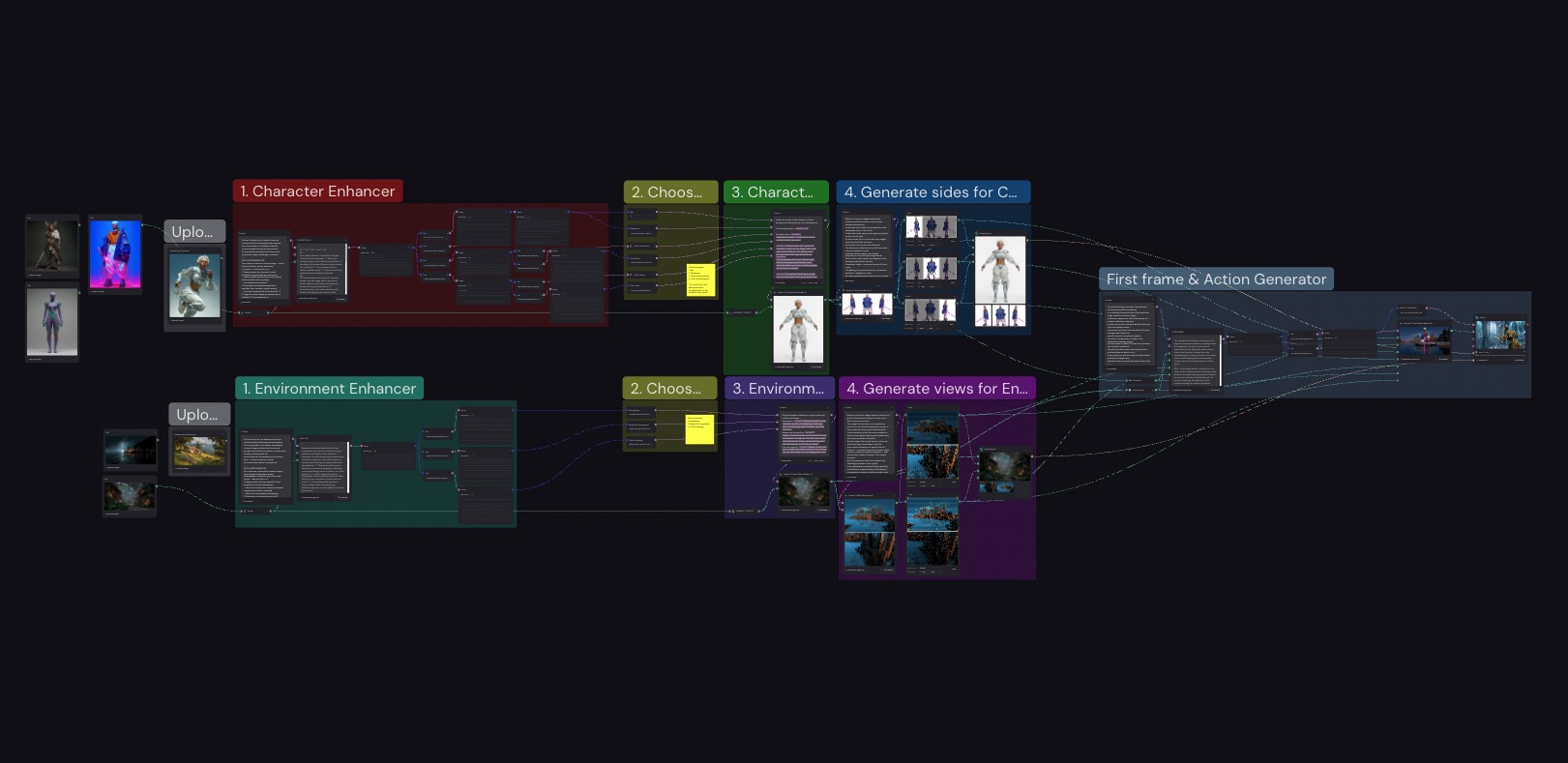
The workflow runs in two parallel tracks — Character and Environment — that converge at the end into a First Frame and action sequence.
Character pipeline
Upload a reference image of your character. The Character Enhancer analyses the input and proposes variations across four dimensions: age, expression, outfit, and colour palette. From those suggestions, choose the direction that fits your brief. The system then generates a full character sheet — multiple views with consistent design — ready to carry into the environment stage.
Environment pipeline
Upload a reference image of your environment. The Environment Enhancer can either preserve the defining characteristics of the original — its shapes, materials, scale — or propose new directions across atmosphere, composition, and lighting. Choose from the suggestions, and the system generates multiple environment views that establish the space.
First frame & action generator
Once both pipelines have produced their outputs, they feed into the First Frame & Action Generator. This stage composites character and environment into a single cohesive image — the first frame — and from it generates three distinct directions for a short 3-shot video sequence in which the character interacts with the space. Each direction proposes different action, framing, and pacing, giving the creative team concrete material to react to at the earliest stage of production.
Notes
CHEDA started as a personal exploration of how much of the early character-environment relationship could be resolved before the first formal concept is approved. The workflow is particularly useful for pitching — being able to show a first frame and three action directions from a rough reference image changes the nature of the conversation from abstract to concrete. It is ideal for trying out ideas quickly without locking anything in.